
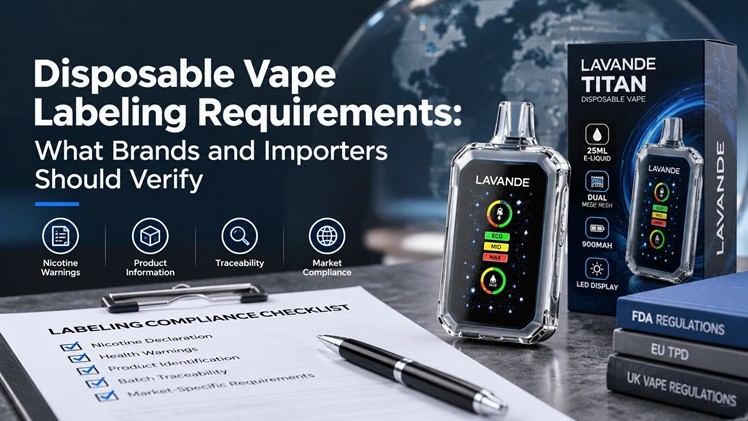
Disposable vape labeling requirements are not limited to printing a nicotine warning on a retail box. For electronic cigarette brands, importers, and regulatory compliance teams, packaging review also involves product identification, accurate nicotine declarations, traceability records, responsible-party information, and the rules governing the intended destination market.
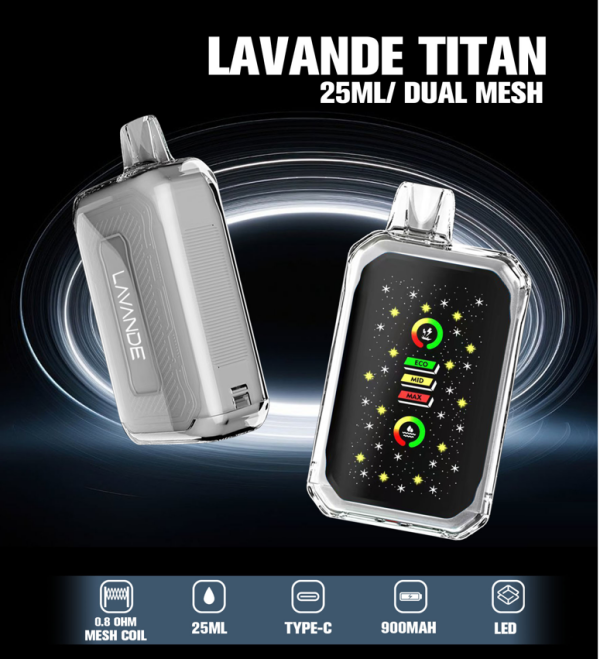
A product label may be factually accurate yet still fail to meet applicable legal requirements. For example, a nicotine concentration printed correctly on a package does not establish that the product is authorized for sale in a particular country. Similarly, a product’s model number and technical specifications do not replace batch records, market-specific warnings, or required regulatory submissions.
This guide explains how to approach disposable vape labeling requirements as a structured compliance review. It also uses the Lavande Titan Disposable as a product-information case study to illustrate the difference between published specifications and independently verified regulatory compliance.
What Are Disposable Vape Labeling Requirements?
Disposable vape labeling requirements are the legal and technical obligations that may govern information displayed on electronic cigarette products, retail packaging, accompanying leaflets, and related documentation. Their scope depends on the jurisdiction, product classification, nicotine content, and applicable legislation.
A comprehensive labeling review should distinguish three separate questions:
- Is the information accurate? Do the product name, nicotine declaration, liquid capacity, and other specifications match the actual product and supporting records?
- Is the required information present? Are applicable health warnings, manufacturer or responsible-party details, product identifiers, and other mandatory statements included in the required format?
- Is the product legally eligible for the market? Does the destination jurisdiction permit the product category, configuration, nicotine concentration, and proposed commercial activity?
These questions are related but not interchangeable. Accurate packaging does not establish market authorization, and market authorization cannot be assumed from a manufacturer’s product description.
Why Disposable Vape Labeling Rules Differ by Market
There is no single international labeling standard that makes a disposable electronic cigarette lawful for sale in every country. Importers must identify the destination market and confirm the rules currently in force before approving packaging or distribution.
United States: FDA Requirements and Marketing Authorization
In the United States, electronic nicotine delivery systems may fall under the regulatory authority of the U.S. Food and Drug Administration (FDA). Applicable requirements can include nicotine addiction warning statements and restrictions relating to product marketing.
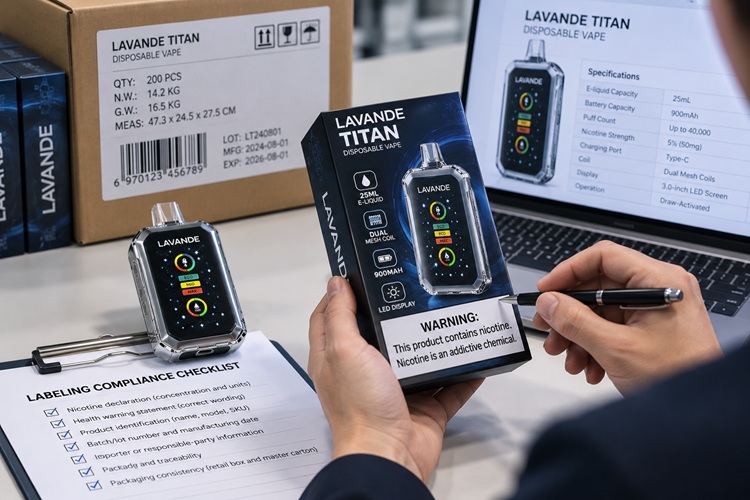
For covered tobacco products containing nicotine, the FDA’s warning statement requirements include the following language:
WARNING: This product contains nicotine. Nicotine is an addictive chemical.
However, the precise application of warning requirements, including formatting and placement, must be checked against the relevant FDA regulations and the product’s classification.
Important: Printing the required warning does not mean that a disposable vape has received FDA marketing authorization. The regulatory status of a specific product must be verified separately.
Official reference: U.S. FDA – Tobacco Products.
European Union: Tobacco Products Directive
Within the European Union, nicotine-containing electronic cigarettes and refill containers are subject to requirements under Directive 2014/40/EU, commonly known as the Tobacco Products Directive (TPD), together with applicable national implementing legislation.
Relevant provisions address matters such as nicotine concentration, certain container capacities, health warnings, information leaflets, and product notification obligations.
For example, Article 20 of the directive establishes a maximum nicotine concentration of 20 mg/mL for nicotine-containing liquid placed on the market under the applicable framework. It also sets capacity limits for relevant cartridges, tanks, and refill containers.
These requirements must be interpreted according to the product’s configuration and the law of the destination member state. National restrictions, including rules concerning flavors, packaging, and disposable products, may differ.
Official reference: Directive 2014/40/EU – EUR-Lex.
United Kingdom: Product Rules and Disposable Vape Restrictions
United Kingdom requirements must be assessed separately from EU rules, particularly where product restrictions or national enforcement measures differ.
The UK introduced a ban on the sale and supply of single-use vapes from 1 June 2025. As a result, checking nicotine concentration, package warnings, or product notification status alone is insufficient to establish whether a disposable product can legally be supplied.
Importers should first determine whether the product is within the scope of the single-use vape restrictions, then review any additional rules applicable to products that remain legally marketable.
Official references: UK Government – Single-Use Vapes Ban and UK Government – E-Cigarette Regulations.
Market-by-Market Compliance Overview
| Market | Key Regulatory Considerations | Importer Verification Priority |
|---|---|---|
| United States | FDA requirements, nicotine warnings, and product marketing authorization | Confirm product-specific authorization status and applicable warning rules |
| European Union | TPD requirements, nicotine limits, container capacity, notifications, and national rules | Review product configuration and destination-country legislation |
| United Kingdom | Single-use vape restrictions and applicable e-cigarette regulations | Establish whether the product category may legally be supplied |
| Other Markets | Country-specific restrictions, import controls, packaging rules, and product registration | Obtain current local regulatory guidance before distribution |
Compliance note: This table is an introductory comparison, not a complete legal determination. Requirements and enforcement policies can change, so the current official rules should be reviewed for each target market.
Nicotine Declaration and Health Warning Verification
Nicotine information is one of the most important elements of e-cigarette labeling compliance. Brands and importers should verify not only the number printed on a package but also what that number means.
Confirm the Nicotine Concentration and Units
Nicotine strength may be expressed as a percentage, a concentration in milligrams per milliliter (mg/mL), or another declaration required or permitted by the destination market.
When reviewing a nicotine declaration, confirm:
- Whether the stated percentage uses a clearly defined measurement basis.
- Whether the mg/mL declaration is consistent with the product formulation.
- Whether the figure refers to concentration or total nicotine quantity.
- Whether the same declaration appears consistently on the retail package, product documentation, and online listing.
- Whether the declared concentration is permitted in the intended market.
For example, the Lavande Titan product information includes a declared nicotine strength of 5%, alongside a reference to 50mg. These figures should not be treated as an independently verified concentration or as a statement of total nicotine content without confirming the measurement basis and supporting formulation documentation.
Verify Health Warning Wording and Presentation
A warning statement must be reviewed against the requirements of the destination jurisdiction. Simply including a general statement about nicotine does not establish compliance.
The review should consider:
- Whether the required warning text is reproduced accurately.
- Whether the warning appears on the correct packaging surfaces.
- Whether minimum size, prominence, contrast, or placement requirements apply.
- Whether the destination market requires particular languages.
- Whether any additional information leaflet or consumer notice is mandatory.
Importers should request final packaging artwork and physical samples rather than relying exclusively on product-page images or supplier descriptions.
Product Identification and Batch Traceability
Product identification and traceability help compliance teams connect physical inventory with product specifications, manufacturing records, quality investigations, and corrective actions.
Depending on the market and applicable rules, relevant information may include:
- Product name and model identification.
- Manufacturer, importer, or other legally responsible entity.
- Batch or lot identification.
- Applicable contact or address information.
- Product-specific regulatory identifiers or notification references.
- Supporting records that connect the finished product to its production batch.
Not every item in this list is universally mandatory on every package. The importer must distinguish legally required label content from additional traceability controls adopted for quality assurance.
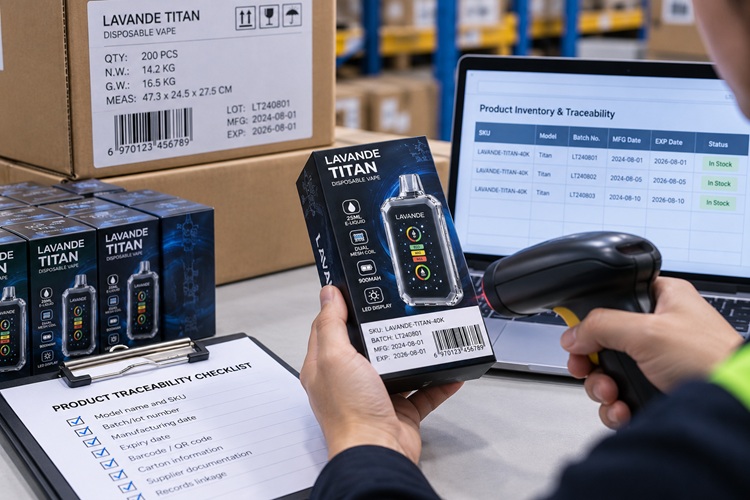
Why a SKU Is Not the Same as a Batch Number
A stock keeping unit (SKU) generally identifies a commercial product configuration. A batch or lot number identifies a defined production group or traceable manufacturing unit.
For example, the SKU LAVANDE-TITAN-40K can help identify a product model, but it does not by itself demonstrate that individual manufacturing batches can be traced.
For an effective traceability review, importers should verify whether batch identifiers on the physical product or packaging can be linked to relevant production and quality records.
Packaging and Technical Specification Verification
Disposable vape packaging requirements can involve both legally mandated statements and the accuracy of voluntary commercial claims.
Even when a particular technical feature is not required to appear on a retail label, any claim that is displayed should be supported by reliable product information.
Common Specifications Requiring Review
| Specification | What Should Be Verified? | Potential Issue |
|---|---|---|
| E-liquid capacity | Declared volume, measurement basis, and product configuration | Incorrect quantity or capacity exceeding a market limit |
| Nicotine strength | Concentration, units, formulation records, and market restrictions | Ambiguous or inconsistent declaration |
| Battery capacity | Declared rating and supporting technical documentation | Unsubstantiated specification |
| Advertised puff count | Claim definition, test conditions, and supporting evidence | Performance claim lacking a documented basis |
| Heating element | Actual component configuration and accuracy of any printed claim | Mismatch between documentation and finished product |
| Product model | Consistency across retail packaging, cartons, and records | Identification or inventory errors |
Advertised puff counts require particular care. A statement such as “up to 40,000 puffs” should not be interpreted as a guaranteed result for every device or user. Its evidentiary basis and the legal acceptability of the claim must be evaluated separately.
Importer Compliance Checklist for Disposable Vape Packaging
Before approving a product for a destination market, compliance and quality teams can use the following checklist to organize their review.
| Review Area | Verification Action | Suggested Evidence |
|---|---|---|
| Market eligibility | Determine whether the product category and configuration may legally be marketed | Current official regulations and product-specific authorization records, where applicable |
| Nicotine declaration | Confirm concentration, units, and consistency | Formulation documentation and final packaging artwork |
| Health warnings | Check required wording, language, prominence, and placement | Approved artwork and physical packaging sample |
| Product identification | Verify model, SKU, and applicable responsible-party details | Product specification sheet and packaging sample |
| Batch traceability | Confirm traceable lot identification and supporting records | Batch records and product-to-lot mapping |
| Technical claims | Compare declared specifications with supporting evidence | Technical files and relevant test documentation |
| Packaging consistency | Compare retail units, master cartons, and digital product listings | Final artwork, carton labels, and approved product data |
| Final review | Document unresolved issues and obtain the required approval before distribution | Signed compliance review or internal approval record |
This checklist is an organizational tool. It does not replace any mandatory conformity assessment, registration, authorization, or other legal obligation.
Product Information Case Study: Lavande Titan Disposable
The Lavande Titan Disposable provides an example of how published product specifications can be used to begin a packaging and documentation review.
The following information is based on the product details supplied for this case study. It should be treated as declared product information, not as independently verified test results or evidence of regulatory approval.
Declared Product Information
| Item | Declared Information |
|---|---|
| Product model | Lavande Titan Disposable |
| SKU | LAVANDE-TITAN-40K |
| Product type | Disposable electronic cigarette |
| Prefilled e-liquid capacity | 25 mL |
| Battery capacity | 900 mAh |
| Advertised puff count | Up to 40,000 |
| Declared nicotine strength | 5%, with a separate 50mg reference requiring clarification |
| Heating element | Dual mesh coils |
| Display | 3.0-inch full LED screen |
| Operation | Draw-activated |
| Retail packaging | 1 unit per box |
| Shipping carton | 200 units per carton |
| Carton dimensions | 47.3 × 24.5 × 27.5 cm |
| Carton gross weight | 16.5 kg |
What Can Be Established from These Specifications?
The declared information identifies the product model and describes several commercial and technical characteristics. It also provides a starting point for comparing product listings, packaging artwork, and supporting documents.
However, the supplied specifications do not establish:
- Whether the product has authorization to be marketed in the United States or any other jurisdiction.
- Whether its nicotine declaration is supported by independently verified formulation data.
- Whether the retail package contains legally required health warnings.
- Whether batch identifiers and responsible-party information appear in the required locations.
- Whether advertised performance claims have supporting test evidence.
- Whether the product’s configuration is eligible for sale in the intended destination market.
Market Eligibility Must Be Assessed Before Label Approval
Two declared specifications warrant particular attention: the 25 mL prefilled capacity and the 5% nicotine declaration.
These values cannot be assumed to meet the requirements of markets that impose lower nicotine concentration limits, smaller reservoir capacity limits, or restrictions on disposable products.
For example, EU requirements concerning nicotine concentration and applicable container capacities mean that the declared configuration requires careful assessment before any proposed EU market entry. In the United Kingdom, the single-use vape ban presents an additional fundamental restriction.
These observations do not establish the product’s legal status in every jurisdiction. They demonstrate why a destination-specific regulatory assessment must precede packaging approval and distribution decisions.
For the original published specifications, refer to the Lavande Titan product information page.
Common Disposable Vape Labeling Mistakes
Several recurring documentation and labeling problems can create compliance risks.
1. Treating a Warning Label as Proof of Authorization
A nicotine warning may be required, but its presence does not establish that a product has been authorized for marketing or that its sale is permitted.
2. Using Ambiguous Nicotine Units
Declarations such as “5%” or “50mg” can be misleading when the concentration basis or unit reference is unclear. Documentation should explain precisely what each figure represents.
3. Reusing the Same Packaging Across Different Markets
Packaging that is appropriate for one jurisdiction may omit mandatory information or contain an impermissible product declaration in another.
4. Confusing Product Identification with Batch Traceability
A model name or SKU does not automatically provide production-batch traceability. These functions should be assessed separately.
5. Publishing Unsupported Performance Claims
Advertised battery capacities, puff counts, and other performance statements should have an appropriate evidentiary basis. Claims should not be presented as guaranteed results without support.
6. Relying Only on Digital Product Listings
A website specification table cannot confirm the wording, location, size, or legibility of information printed on a physical package.
Recommended Documentation Review Process
A structured review can help brands and importers identify information gaps before a product is considered for distribution.
- Define the destination market. Identify the country and the relevant product classification.
- Check product eligibility. Review applicable prohibitions, concentration and capacity limits, and marketing authorization requirements.
- Collect product documentation. Obtain the current specification sheet, formulation declarations, packaging artwork, and relevant supporting records.
- Inspect physical packaging. Compare retail units and shipping cartons against the approved documentation.
- Verify required statements. Confirm warning wording, product identification, responsible-party information, and other applicable label elements.
- Review traceability. Determine whether batch identifiers can be connected to relevant production records.
- Resolve discrepancies. Record missing evidence, conflicting declarations, and necessary corrections.
- Complete the appropriate regulatory review. Obtain required approvals or authorizations before any legally restricted commercial activity.
The purpose of this process is to identify compliance questions early and preserve a clear record of how they were evaluated. It should be adapted to the applicable law and the organization’s regulatory responsibilities.
Frequently Asked Questions
What information should importers verify on disposable vape packaging?
Importers should check applicable nicotine declarations, health warnings, product identification, responsible-party details, batch traceability, and any other information required by the destination market. They should also confirm whether the product itself is legally eligible for distribution.
Are disposable vape labeling requirements the same in every country?
No. Different jurisdictions may impose different rules on nicotine concentration, container capacity, warning statements, product notification, marketing authorization, and disposable product sales. Packaging should be assessed against the current requirements of each intended market.
Does a nicotine warning label mean a disposable vape is legally authorized for sale?
No. A warning label is not evidence of marketing authorization, product registration, or overall legal compliance. These requirements must be evaluated independently.
Why is batch traceability important for electronic cigarette products?
Batch traceability helps connect finished products with manufacturing records, quality investigations, and corrective actions. The specific labeling and recordkeeping obligations depend on the applicable jurisdiction.
Can a disposable vape with 25 mL of e-liquid and a declared 5% nicotine strength be sold in every market?
No. Some jurisdictions restrict nicotine concentration, liquid capacity, or disposable electronic cigarette sales. The product’s configuration must be assessed under the rules of each destination market. The declared figures alone cannot establish legal eligibility.
Is a product SKU sufficient for traceability?
Not necessarily. A SKU typically identifies a commercial product configuration, while batch or lot identification connects products to particular manufacturing records. Both may be useful, but they serve different purposes.
Should importers rely on product-page specifications when approving packaging?
No. Product-page specifications can support an initial review, but they should be compared with current technical documentation, final packaging artwork, physical samples, and any evidence required by applicable law.
Conclusion: Accurate Labeling Begins with Market-Specific Verification
Understanding disposable vape labeling requirements requires more than checking whether a retail box contains a warning or a nicotine percentage. Brands and importers must distinguish accurate product information from mandatory label content and, most importantly, from the separate question of whether the product may legally be marketed in the intended jurisdiction.
The Lavande Titan case study illustrates this distinction. Published specifications can identify areas requiring verification, but they cannot independently establish product authorization, regulatory compliance, or suitability for a particular market.
A responsible compliance review should therefore begin with current destination-market rules, continue through documentation and physical packaging checks, and conclude only when unresolved issues have been appropriately addressed.
Regulatory disclaimer: This article provides general educational information and is not legal advice or a certification of product compliance. Regulations may change, and product-specific determinations should be based on current official requirements and qualified regulatory review.